⚡ Architecture Summary: Next.js vs. WordPress
In 2026, traditional WordPress remains the premier choice for marketing blogs, editorial teams, and standard corporate sites requiring rapid non-technical content management. Next.js 15 is the superior engineering choice for complex web applications, customer portals, interactive SaaS products, and ultra-high-traffic platforms demanding sub-second TTFB, edge rendering, and zero plugin security vulnerabilities.
When leadership teams and technical founders evaluate modern web infrastructure, one debate surfaces constantly: Should we build on WordPress or invest in a modern JavaScript framework like Next.js?
Too often, agencies present this decision as an ideological battle. In reality, both stacks are powerful tools designed to solve fundamentally different operational problems. Choosing the wrong architecture can either lock your marketing team behind an expensive engineering bottleneck or cripple your customer application with slow database queries and plugin vulnerabilities.
In this technical architecture guide, we analyze Next.js 15 and WordPress across real-world metrics: performance, security, developer ergonomics, editorial agility, and long-term total cost of ownership.
1. Technical Architectural Comparison
Here is how the two technologies compare across critical production dimensions:
| Architecture Metric | Next.js 15 (React 19) | Bespoke WordPress (PHP 8.3) | Page-Builder WordPress (Elementor/Divi) |
|---|---|---|---|
| Time to First Byte (TTFB) | 50ms – 180ms (Vercel / Cloudflare Edge) | 120ms – 250ms (LiteSpeed / Redis Object Cache) | 600ms – 2,200ms (Heavy DB queries) |
| Rendering Strategy | Server Components (RSC), SSR, SSG, ISR | Server-Side Dynamic (PHP) + HTML Page Cache | Client-heavy DOM hydration + slow PHP rendering |
| Security Attack Surface | Virtually Zero (Static assets + stateless serverless APIs) | Low (Hardened custom code, no 3rd-party plugin bloat) | High (Marketplace plugins represent 95%+ of CVEs) |
| Dynamic User State | Exceptional (Real-time WebSockets, React State, Prisma) | Moderate (Requires REST API or admin-ajax endpoints) | Poor (Complex multi-step state often breaks) |
| Non-Technical Content Editing | Requires Headless CMS (Sanity, Strapi, WP GraphQL) | Native Gutenberg / Block Editor (Instant & intuitive) | Visual drag-and-drop (Prone to layout breakage) |
Achieving sub-second performance across either platform requires disciplined optimization. If you are auditing your current site speed, consult our step-by-step Core Web Vitals Optimization Checklist to see how we eliminate render-blocking assets and hit 100/100 Lighthouse scores.
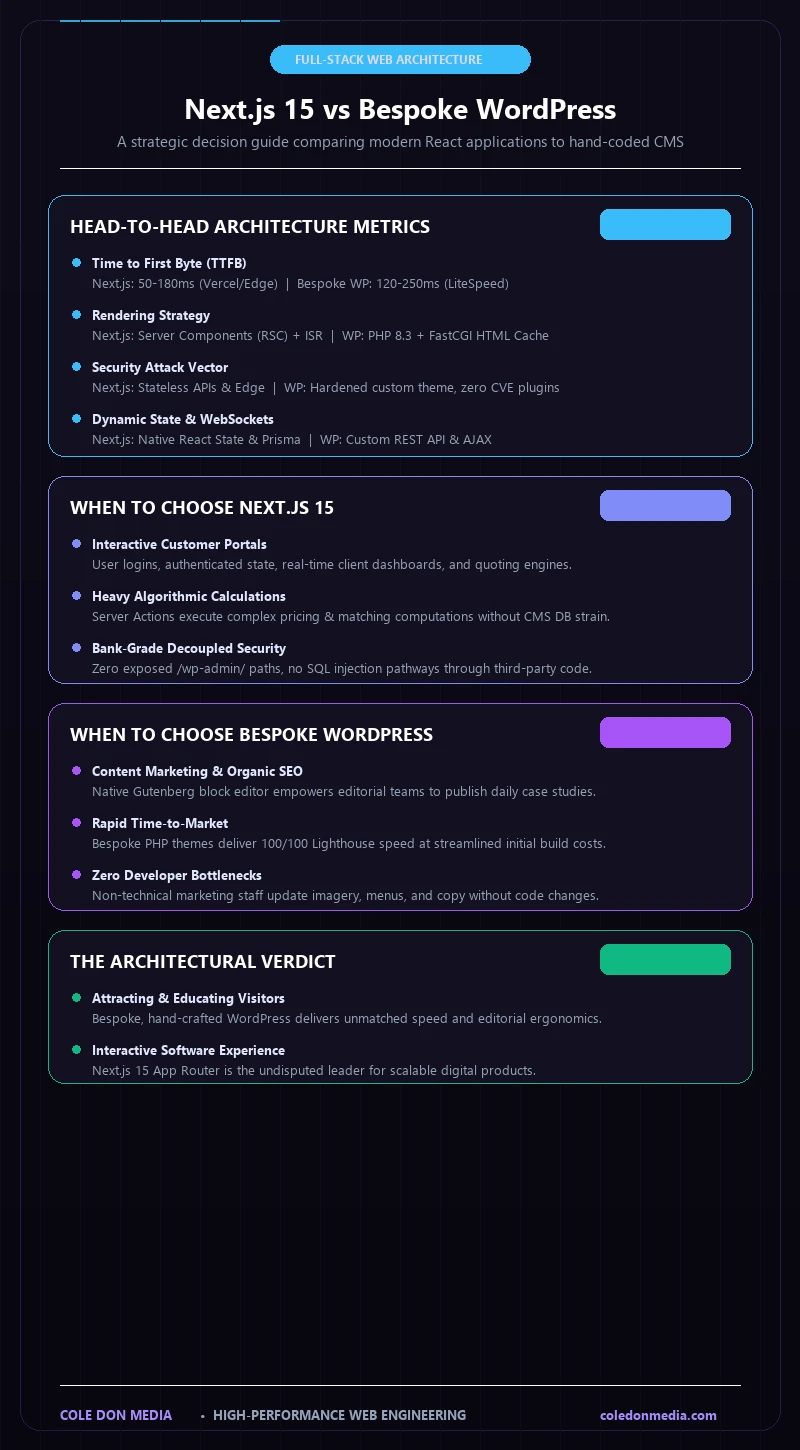
2. When to Choose Next.js 15 for Your Digital Platform
Next.js is not just a website builder—it is a full-stack React framework optimized for high-performance applications. You should choose custom Next.js web application development when your product requires:
A. Interactive Dashboards & Customer Portals
If your users log in to manage accounts, process data, view real-time charts, or perform complex transactions, Next.js is leagues ahead of traditional CMS platforms. React’s component state model enables fluid, instantaneous user interactions without full-page reloads.
B. Custom Calculation Engines & Algorithms
Whether you are building an interactive quoting calculator, a multi-parameter configuration tool, or algorithmic matching software, Next.js Server Actions and API routes execute heavy computations efficiently on edge networks without taxing a CMS database.
C. Bank-Grade Security Requirements
Because Next.js separates the public-facing application from the backend database, there is no exposed `/wp-admin/` login portal, no SQL injection pathways through third-party plugins, and no outdated PHP files sitting in public web directories.
D. Global Edge Distribution & Sub-Second Latency
Deploying Next.js on edge infrastructure (such as Vercel, AWS Amplify, or Cloudflare Workers) means your application code executes geographically adjacent to your user, delivering near-instant page loads worldwide.
3. When to Choose Bespoke WordPress
Despite the rise of headless frameworks, WordPress powers over 40% of the internet for a reason: when engineered properly with clean, custom PHP code, it is an unbeatable content management system.
You should choose custom WordPress when:
- Your Core Engine is Content Marketing & SEO: If your marketing team publishes several articles, case studies, and landing pages every week, the native WordPress Gutenberg editor offers the smoothest, most intuitive publishing workflow available.
- Rapid Time-to-Market for Corporate Sites: A custom-engineered WordPress theme delivers 100/100 Lighthouse performance while allowing internal teams to manage text, imagery, and menus without needing a software engineer for every minor update.
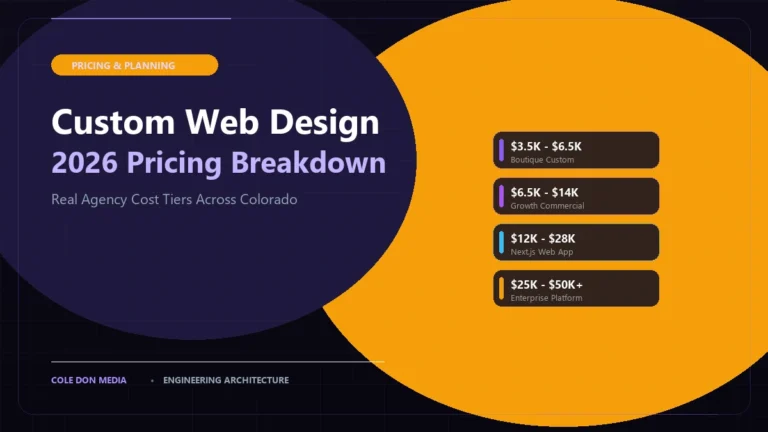
- Budget Efficiency: Custom WordPress sites typically require fewer development hours to set up than a fully decoupled headless Next.js frontend with an external CMS backend. For transparent pricing tiers and agency cost breakdowns across both platforms, read our 2026 Guide to Custom Web Design Costs in Colorado.
Crucial distinction: When we say “WordPress,” we mean bespoke, hand-coded themes built in modern PHP 8.3 with zero page builders. If you have an existing WordPress site weighed down by 30+ plugins, check out our guide on eliminating WordPress plugin bloat.
4. The Headless Hybrid: Best of Both Worlds?
For brands that need enterprise React power alongside an intuitive editing experience, a Headless WordPress + Next.js architecture is a compelling compromise. In this setup:
- WordPress acts solely as the backend database and editorial portal (via WPGraphQL or REST API).
- Next.js 15 acts as the high-speed frontend, pulling data during Incremental Static Regeneration (ISR).
While this architecture offers unmatched frontend speed, it does introduce dual-hosting costs and increased maintenance complexity. We evaluate your team’s internal resources before recommending a headless migration.
5. Architectural Decision Matrix: Which is Right for You?
🧭 Quick Rule of Thumb
If your primary objective is attracting and educating visitors through content, choose a bespoke, hand-crafted WordPress site. If your primary objective is providing an interactive software experience or processing transactions, choose Next.js.
At Cole Don Media, we architect both platforms natively. We don’t force a single template on every client; we evaluate your 24-month roadmap to build an infrastructure that scales with your growth.
Ready to discuss your platform architecture? Book a technical consultation with Cole Norton, test your scope in our interactive project estimator, or explore our Next.js engineering capabilities.