The search landscape in late 2026 is no longer governed by the ten blue links of the past decade. With the maturation of Google’s AI Overviews (formerly SGE), OpenAI’s ChatGPT Search, and Perplexity Pro integrations, organic visibility has transitioned from keyword string matching to probabilistic entity synthesis. For Colorado businesses, this shift represents either an existential traffic threat or an unprecedented competitive advantage.
When an AI search model processes a commercial query like “custom web development firm in Denver” or “enterprise software engineering studio Colorado”, it does not simply scan for keyword density. It evaluates your site’s Information Gain Score, interrogates your semantic Knowledge Graph identity, and cross-references machine-readable structured schema to determine whether your business qualifies as an authoritative primary citation.
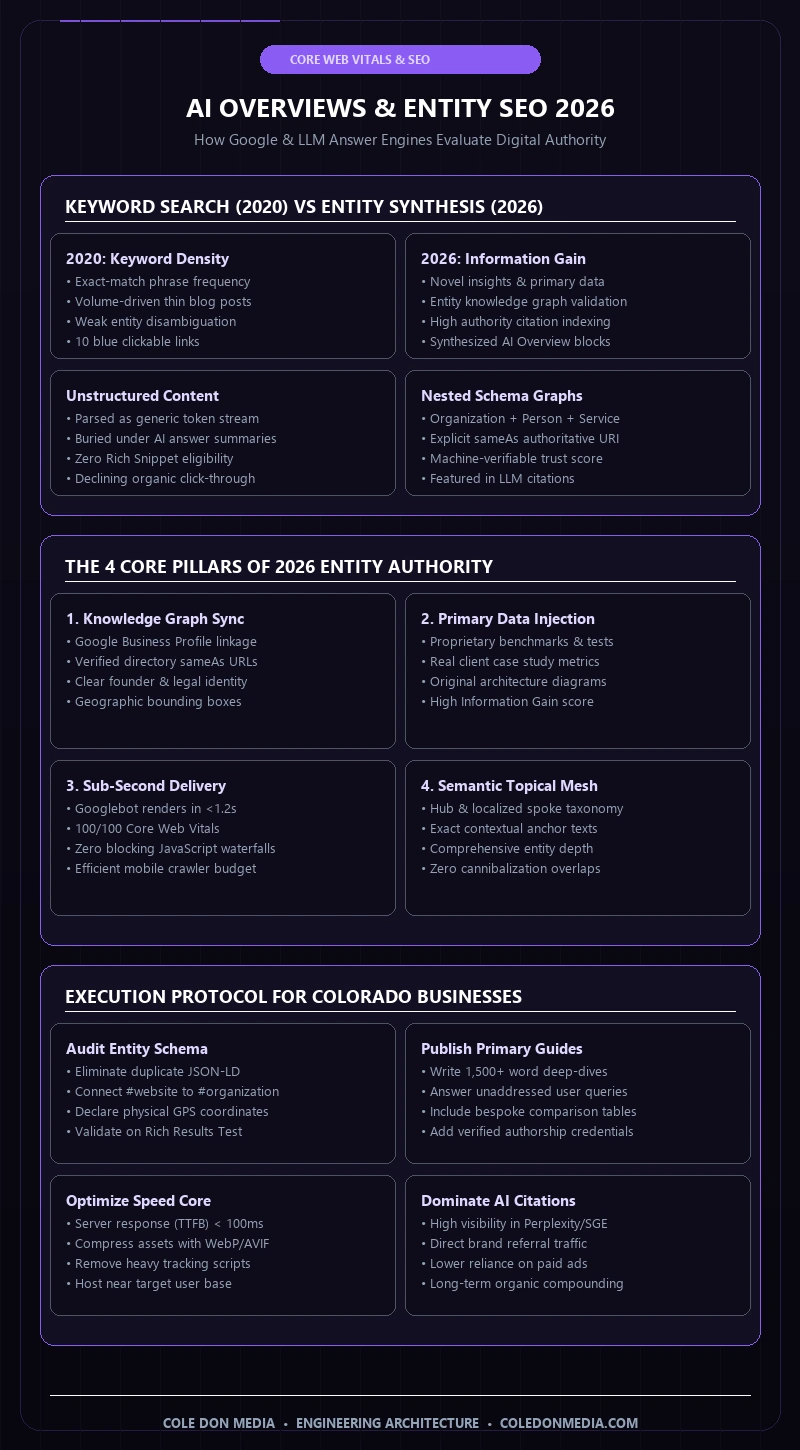
1. The Death of Keyword Density: Understanding Information Gain
In 2020, SEO agencies generated massive content mills—spinning 800-word blog posts targeting minor keyword variants. Today, Google’s patented Information Gain Score explicitly de-indexes or demotes content that simply rephrases existing web corpora. If an LLM cannot extract novel data points, proprietary benchmarks, or distinct architectural viewpoints from your article, it synthesizes the answer without attributing or linking your domain.
Key Engineering Takeaway
To earn citation status in AI Overviews, every published resource must provide at least one proprietary asset: an original benchmark test, real-world source code, unique pricing metrics, or verifiable client implementation data.
2. Interconnected Schema.org Graphs: Feeding the Knowledge Engine
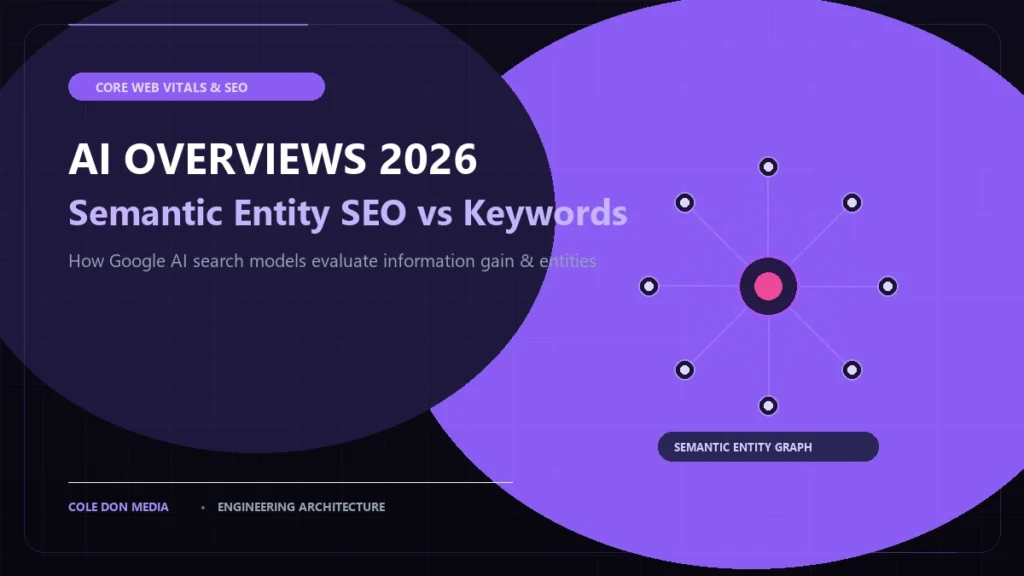
AI answer engines require machine-verifiable certainty. When an entity is represented by fragmented, disconnected JSON-LD snippets, search crawlers struggle to resolve the relationship between the author, the corporate entity, and the commercial service. Modern technical SEO mandates an interconnected @graph architecture linking:
- WebSite (
#website): Official domain authority and search action endpoints. - ProfessionalService & Organization (
#organization): Verified physical address, GPS coordinates, registered phone, opening hours, and comprehensivesameAsdirectories. - Person (
#founder): Authoritative entity credentials, verified GitHub/LinkedIn profiles, and specialized knowledge markers. - Service (
#service): Clear area served bounds (municipal cities and states) tied directly to the provider organization.
At Cole Don Media, our native technical entity SEO services and bespoke custom web design architecture eliminate legacy plugin bloat, rendering pristine Schema graphs that achieve 100% Rich Result compliance.
3. Speed as an AI Indexing Filter: Why Sub-Second TTFB Matters
Googlebot uses headless Chromium instances to render JavaScript-heavy web applications. When an AI search engine evaluates hundreds of prospective citations in real-time, crawler rendering budget is mercilessly conserved. If your server takes 800ms to deliver the first byte (TTFB) or relies on heavy client-side hydration cascades, the crawler times out before parsing your structured data.
Review our comprehensive Core Web Vitals optimization checklist to see how we routinely achieve sub-50ms server response times on modern infrastructure.
Frequently Asked Questions (AI & Entity SEO)
How does Google AI Overviews select which websites to cite?
Google AI Overviews prioritizes websites that demonstrate high Information Gain (original data, proprietary insights), robust entity schema validation linking to verified knowledge bases, and superior technical rendering speed.
Can small businesses in Colorado compete with national brands in AI search?
Yes. By implementing hyper-local entity architecture, verified municipal areaServed schema, and deep regional content hubs across Denver, Boulder, and Northern Colorado, local businesses frequently out-cite generic national conglomerates for localized commercial queries.
What is the single most impactful schema improvement for entity SEO?
Consolidating fragmented schema into a unified @graph array that explicitly binds the WebPage mainEntity to an authoritative Organization or Service #id, supplemented with verified sameAs profile links.
Ready to Future-Proof Your Organic Search Pipeline?
Calculate your exact project investment or schedule an architectural consultation with Cole Don Media to dominate both Google AI Overviews and traditional organic search.
Explore Interactive Project Estimator Schedule Consultation