When consumer packaged goods transition from direct-to-consumer e-commerce to wholesale retail shelves—whether Whole Foods, Target, or regional specialty stores—packaging is no longer just a canvas for graphic design. It is a piece of three-dimensional mechanical engineering. A stunning visual label on a flimsy paperboard substrate that bows under stacking weight, or a dieline with improper score clearances that bursts on automated folder-gluers, will result in catastrophic retail chargebacks and rejected shipments.
Packaging design requires mastering paperboard physics, pre-press spot-color layer conventions, structural dielines, and folder-gluer adhesive clearances. Here is the technical prepress blueprint for launching retail-ready folding cartons and corrugated packaging.
Preflight Verification Checklist
- Layer Separation: Dieline vector geometry placed on a dedicated layer set strictly to Spot Color Overprint.
- Exterior Bleed: Minimum 0.125" (3.175mm) beyond cut lines on all exterior perimeter edges.
- Live Area Safety: Minimum 0.0625" (1.6mm) clearance from all internal score, crease, and fold lines.
- Glue Flap Knockout: 100% ink and aqueous coating knockout on manufacturer's joint glue flaps to ensure adhesive bonding.
1. Substrate Selection: Calipers, SBS vs. CRB & Corrugated Fluting
Paperboard thickness is specified in caliper points (where 1 point = 0.001 inches). Choosing the wrong caliper leads to either structural box collapse or wasteful material expenditure that erodes product margins:
| Substrate Type | Typical Caliper / Rating | Physical Characteristics & Best Applications |
|---|---|---|
| SBS (Solid Bleached Sulfate) | 14pt to 24pt (0.014" – 0.024") | 100% virgin bleached wood pulp. Pure white top and reverse. Superior structural stiffness and ink fidelity for cosmetics, pharma, and luxury food. |
| CRB (Coated Recycled Board) | 18pt to 28pt | 100% recycled fibers with clay-coated white exterior and grey kraft interior. Cost-efficient choice for dry groceries, cereal boxes, and hardware. |
| E-Flute Corrugated | 1/16" thickness (~90 flutes/ft) | High crush resistance with flat printing surface. Ideal for direct-to-consumer mailer boxes and heavy retail shelf items (spirits, electronics). |
| B-Flute Corrugated | 1/8" thickness (~47 flutes/ft) | Heavy-duty puncture and compression strength (ECT 32 / ECT 44). Standard for master shipping cartons and point-of-purchase (POP) displays. |
Grain Direction Rule: The grain of the paperboard must run parallel to the primary score lines of the carton. If the grain runs perpendicular, folding the carton breaks the cellulose fibers, causing unsightly cracking and score line rupture along the edges.
2. Structural Dieline Drafting: Layer Hierarchy
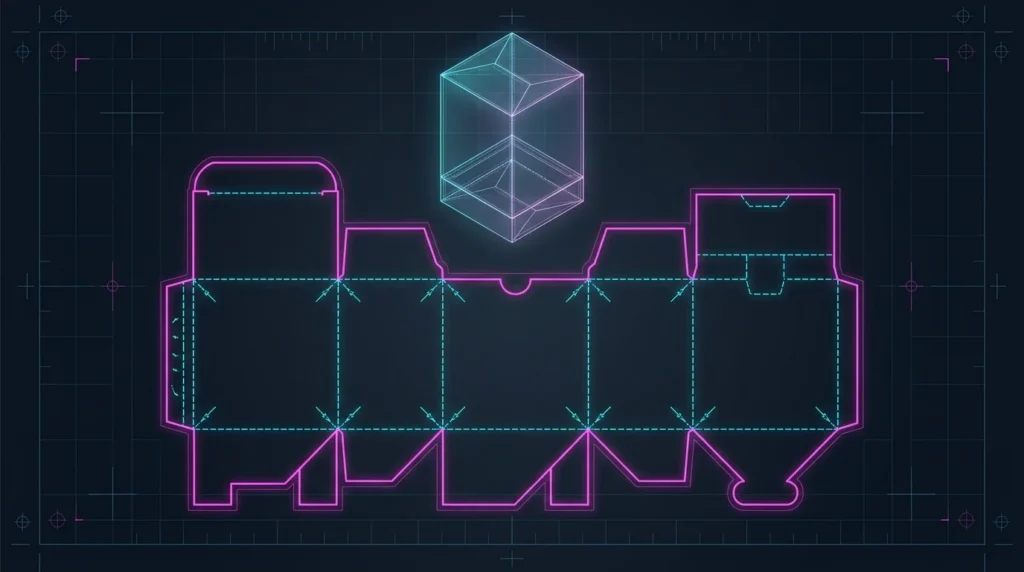
A commercial packaging dieline is a CAD vector file that guides steel rule cutting dies. In prepress production, dieline paths must never be drawn in CMYK process colors. They must reside on dedicated spot-color layers explicitly set to Overprint Stroke in preflight:
- Cut Lines (Solid Magenta 100%): Defines the physical perimeter of the unfolded blank. Spot color named
Die_Cut. - Crease / Score Lines (Dashed Cyan 100%): Where steel creasing rules indent the substrate to form folds. Spot color named
Crease. - Perforations (Dotted Green 100%): Alternating cut-and-tie points for tear strips and retail display zip-strips. Spot color named
Perf. - Glue Flap Knockout (Hatched Yellow): Areas reserved for PVA or hot-melt adhesives on high-speed folder-gluers.
Setting dieline layers to Overprint prevents the vector rules from knocking out white gaps in the underlying artwork if a plate operator accidentally prints with the dieline layer turned on.
3. Folder-Gluer Adhesive Bonding & Varnish Knockouts
Modern automated folding carton packing lines run at speeds of 30,000 to 60,000 cartons per hour. One of the most catastrophic prepress errors is extending background ink or UV coating across the manufacturer's glue tab.
Industrial adhesives (such as water-based cold PVA glue) rely on porosity to penetrate paperboard fibers. If the glue tab is covered in slick UV gloss varnish, aqueous coating, or dense heavy ink film, the adhesive forms a brittle surface bond instead of penetrating the board. When cartons are loaded with product, the glue seams pop open on the store shelf.
Glue Tab Prepress Rule
Always create an explicit coating knockout mask that leaves the manufacturer's glue tab and its mating interior contact panel 100% bare paperboard, recessed by at least 1/16" (1.5mm) from score lines to prevent adhesive squeeze-out.
Frequently Asked Questions (Packaging Design)
What is trapping in packaging prepress?
Trapping is the deliberate microscopic overlap (typically 0.15pt to 0.5pt) between touching color plates to prevent tiny white flashes caused by natural paper stretch and mechanical plate misregistration on high-speed press runs.
Why can't I just design packaging in standard RGB?
Commercial offset packaging presses use CMYK inks and specialized Pantone spot colors. RGB color gamuts are substantially wider than physical print gamuts; designing in RGB creates unfulfillable client expectations when vivid screen colors get clipped during prepress conversion.
What is ECT vs Mullen Burst Test in corrugated boxes?
The Mullen Burst Test measures the force (in pounds per square inch) required to rupture the side of a box, indicating puncture resistance. Edge Crush Test (ECT) measures vertical top-to-bottom compression strength, indicating how many boxes can be safely palletized on top of one another in a warehouse.
Launch Production-Flawless Packaging
From structural dieline engineering and paperboard selection to prepress trapping and retail compliance, Cole Don Media ensures your products dominate store shelves.
Estimate Packaging Project Request Prepress ReviewExplore Related Colorado Studio Architecture
Ready to turn technical insights into measurable growth? Explore our Colorado Custom WordPress Web Design, Colorado Local SEO & Google Map Pack Optimization, Entity Brand Identity & Logo Systems, and Longmont & Front Range Studio Hubs.