Designing a 10×20-foot trade show exhibit or a 40-foot environmental wall graphic is completely different from designing a digital website or an 8.5×11-inch brochure. When junior designers apply standard brochure rules to environmental dimensions—exporting a 20-foot backdrop at 300 DPI at 100% scale—they generate 15-gigabyte files that choke raster image processor (RIP) print servers, introduce catastrophic compression artifacts, and derail installation deadlines.
Large-format environmental print requires an engineering understanding of human angular visual acuity, Silicone Edge Graphics (SEG) dye-sublimation stretch physics, and calibrated Rich Black ink formulations. Here is the principal production guide for corporate trade show graphics and environmental branding.
Key Engineering Metrics for Large-Format
- Viewing Distance Math: Human eyes with 20/20 vision can only resolve ~1 arcminute. Backdrops viewed from 10 feet require only 100 to 120 PPI.
- Scale Conventions: Design at 1:10 scale at 300–600 PPI or 1:1 scale at 100–120 PPI.
- Tension Fabric Welting: SEG extrusions require exact silicone keder strip bead allowances (typically 12mm × 3mm) and 0.5% to 1.5% stretch compensation.
- Rich Black Calibration: Avoid muddy 100K; utilize
60C 40M 40Y 100Kto achieve deep obsidian tones on dye-sublimated polyester.
1. The Physics of Resolution & Human Viewing Distance
The golden rule of large-format graphics is that resolution is inversely proportional to viewing distance. The human eye evaluates detail through angular resolution (roughly 1 arcminute, or $1/60$th of a degree). At arm's length (12 to 18 inches), 300 PPI is necessary because the eye can discern individual pixels at lower densities. But trade show backdrops and environmental graphics are viewed from 6 to 30 feet away.
The required resolution can be calculated using the optical formula:
Required PPI = 3438 / Viewing Distance in Inches

Example: 10-foot trade show backdrop (120 inches)
PPI = 3438 / 120 = 28.65 PPI (Absolute optical resolving limit)
Production standard: 100 to 120 PPI at 100% scale (delivers 3.5x visual margin of safety)
| Viewing Distance | Minimum Optical PPI | Recommended Prepress File Resolution | Typical Application |
|---|---|---|---|
| Under 3 feet | 100 – 150 PPI | 200 – 300 PPI at 100% scale | Counter graphics, tabletop displays, POS kiosks |
| 3 to 10 feet | 30 – 100 PPI | 100 – 150 PPI at 100% scale | 10ft & 20ft trade show booth walls, SEG fabric frames |
| 10 to 30 feet | 10 – 30 PPI | 50 – 75 PPI at 100% scale | Overhead hanging circular banners, arena concourses |
| Over 30 feet | Sub-10 PPI | 20 – 30 PPI at 100% scale | Highway billboards, building wraps, exterior stadium graphics |
2. Silicone Edge Graphics (SEG) Tension Fabric Engineering
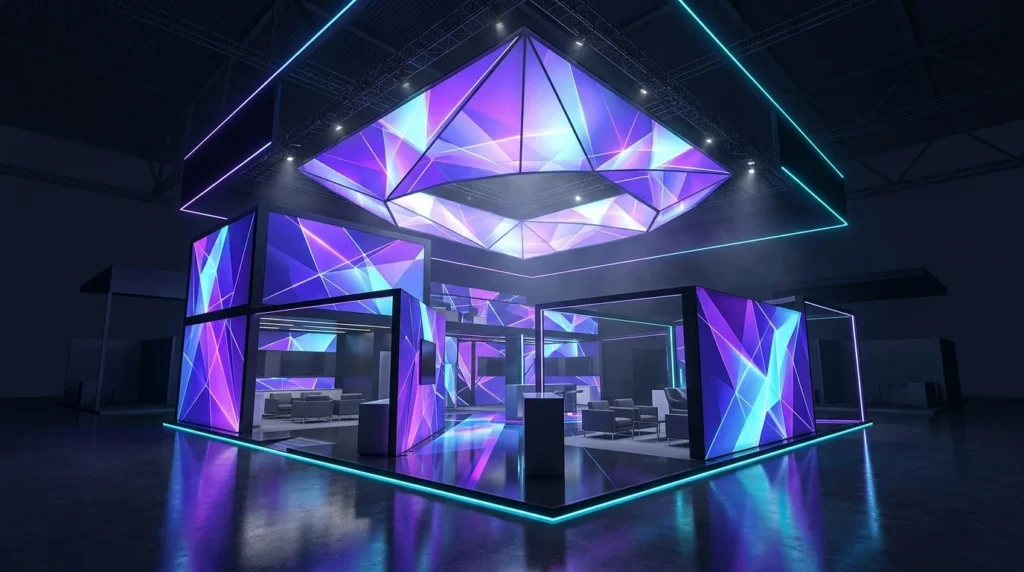
Modern exhibition design has largely transitioned away from heavy, magnetic laminate pop-up panels to Silicone Edge Graphics (SEG). SEG consists of high-definition dye-sublimated polyester fabric with a thin silicone keder strip sewn directly around the perimeter, which slots tightly into recessed aluminum extrusion channels.
Prepress engineering for SEG requires calculating precise fabric stretch and heat-press shrinkage factors:
- Dye-Sublimation Calendering: The transfer process exposes polyester to temperatures between 380°F and 400°F under high pressure, causing 0.5% to 2% mechanical shrinkage depending on fiber weave.
- Keder Welting Allowance: Artwork requires a 0.5" to 0.75" perimeter bleed beyond the frame edge to accommodate the sewn silicone bead.
- Frame Shadow Mitigation: Backlit SEG frames require specialized light-box fabric with internal diffusion coating. Without proper light diffusion, LED perimeter pucks create hot-spots on bright white brand backgrounds.
3. Rich Black Formulations for Large-Format Substrates
A common trap in environmental design is using standard 100% Black (0C 0M 0Y 100K) for large dark backgrounds. In commercial wide-format printing, 100K ink appears as an anemic, washed-out charcoal gray when back-lit or stretched across a 20-foot fabric wall.
To achieve a deep, obsidian black, designers must formulate calibrated Rich Black while respecting the substrate's Total Area Coverage (TAC / Total Ink Limit):
- Dye-Sublimation Fabric Rich Black:
60C 40M 40Y 100K(Total ink: 240%). Delivers pure, pitch-black depth on textured knit fabrics without ink bronzing. - Latex & UV Direct-to-Board (Foamcore/Gator):
40C 30M 30Y 100K(Total ink: 200%). Prevents ink puddle pooling and peeling on non-porous vinyl substrates. - Cool Rich Black (Tech & Architecture):
60C 20M 10Y 100K. Infuses a subtle slate-blue tint that complements modern architectural exhibits.
Frequently Asked Questions (Trade Show Prepress)
Why should large-format files be designed at 1:10 scale?
Vector design applications often struggle with artboards exceeding 200 inches. Designing at 1:10 scale (e.g., 24×12 inches representing 240×120 inches) at 300 to 600 PPI keeps file sizes manageable while allowing print RIP software to scale the asset 1000% seamlessly at print time.
What is the safety margin for grommets and pole pockets?
Banners with metal grommets require at least 2.5 inches of clearance between the edge and any critical text or logo marks. Pole pockets require a clearance equal to the pocket fold depth plus 1 inch (typically 3.5 to 5 inches) to prevent pocket stitching from cutting through brand assets.
What PDF export standard should be used for large format?
Use PDF/X-4:2010. Unlike older PDF/X-1a standards that flatten transparencies into fragmented raster slices, PDF/X-4 preserves live vector transparency layers, allowing modern Adobe PDF Print Engines (APPE) to render gradients and drop shadows without visible tiling lines.
Dominate Your Next Industry Exhibition
Ensure your trade show presence commands the showroom floor with mathematically calibrated resolution, high-impact SEG fabrics, and flawless prepress execution.
Calculate Environmental Print Scope Schedule Prepress ConsultationExplore Related Colorado Studio Architecture
Ready to turn technical insights into measurable growth? Explore our Colorado Custom WordPress Web Design, Colorado Local SEO & Google Map Pack Optimization, Entity Brand Identity & Logo Systems, and Longmont & Front Range Studio Hubs.